
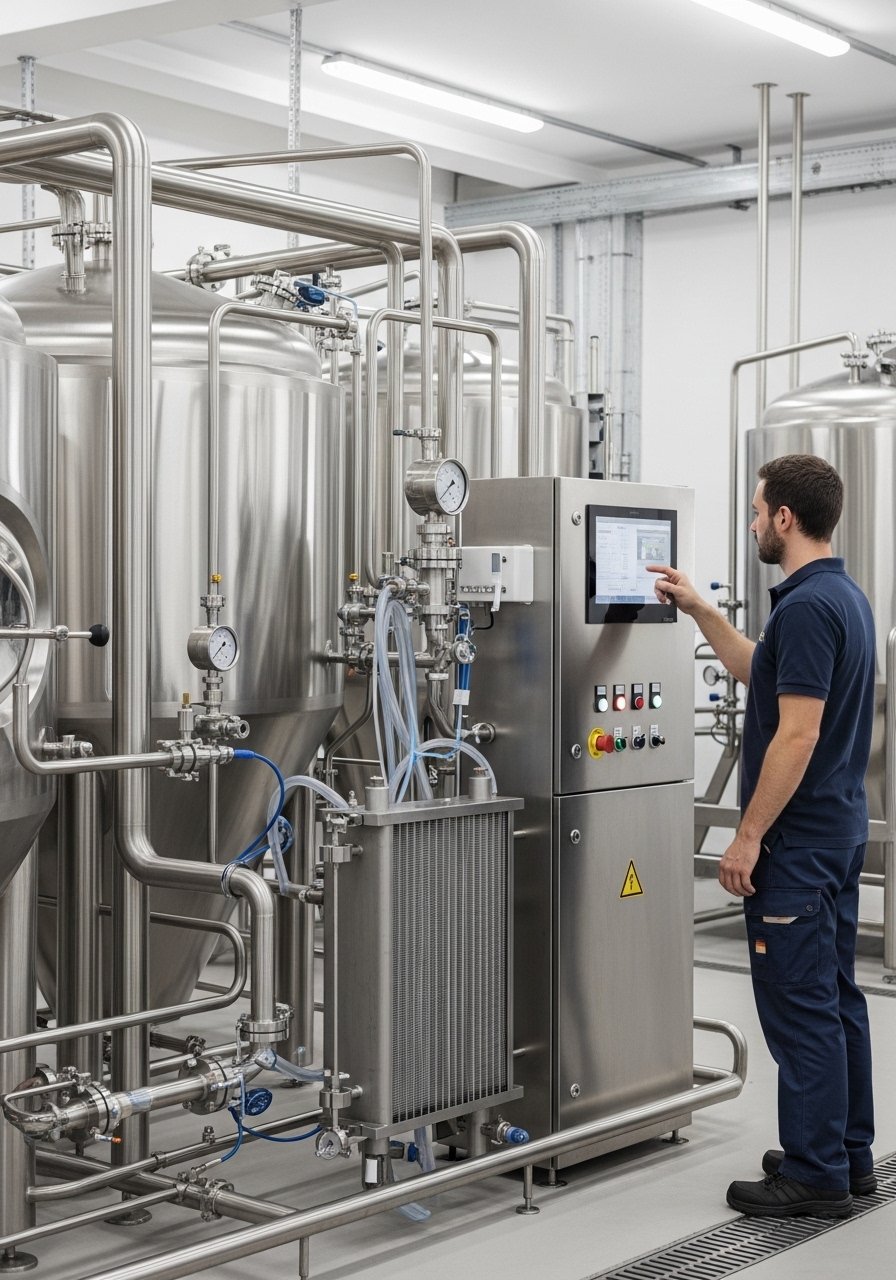
The Big Picture: How a Commercial Brewing System Is Structured
Beer looks simple in a glass. Four ingredients — malt, hops, yeast, and water — transformed into something people travel for, celebrate with, and build businesses around. But at a commercial scale, that transformation happens through a precisely engineered system where every vessel and utility has a defined role.
Every commercial brewery operates as a linked sequence of processes divided into two fundamental stages: the Hot Side, where raw ingredients are converted into wort using heat, and the Cold Side, where wort is transformed into finished beer through fermentation, conditioning, carbonation, and packaging.
What This Guide Explains
- How the hot side works — milling, mash, lauter, kettle, whirlpool
- How the cold side works — heat exchanger, fermenters, glycol, brite tank
- Heating methods — electric, direct fire, and steam systems
- Brewhouse configurations — 2-vessel, 3-vessel, and 4-vessel systems
- Controls and utilities — PLC automation, water, power, gas, drainage, and CIP
How the Hot Side Works: Converting Grain Into Wort
The Milling System
Before grain ever touches water, it goes through a malt mill. The mill cracks each kernel to expose the starchy interior while keeping the outer husk largely intact. This matters because the husk later forms the natural filter bed during lautering.
Under-milling reduces starch exposure and lowers extraction efficiency. Over-milling shreds husks and can cause a slow, stuck lauter. Commercial mills are usually set to a gap around 0.8 to 1.2 mm to optimize extraction without excessive husk damage.
The Hot Liquor Tank (HLT): How It Works
The hot liquor tank is the water heating vessel. It stores and heats brewing water to precise temperatures before it is used elsewhere in the process.
- It heats strike water for mashing, usually 10–15°F above target mash rest temperature.
- It maintains sparge water at 168–170°F (75–77°C) for rinsing sugars from the grain bed.
- Commercial HLTs are usually sized at 1.5–2x kettle volume to keep the brew day moving without reheating delays.
The Mash Tun: How It Works
The mash tun is where the central biochemical transformation happens. Hot water is mixed with milled grains, and the enzymes naturally present in malted barley convert complex starches into fermentable sugars over 60–90 minutes.
The key enzymes are beta-amylase, which produces more fermentable sugars and drier beer, and alpha-amylase, which produces fuller-bodied wort with more residual sweetness.
| Mash Temperature | Enzyme Bias / Brewing Effect |
|---|---|
| 140–149°F (60–65°C) | Beta-amylase dominant — drier, more attenuated beer |
| 148–156°F (64–69°C) | Balanced saccharification range used by most commercial breweries |
| 154–162°F (68–72°C) | Alpha-amylase dominant — fuller body and lower attenuation |
A commercial mash tun typically includes a steam or electric jacket, a stirring or rake system, a false bottom, and recirculation ports. On 2-vessel systems, the mash tun often doubles as the lauter tun. On 3- and 4-vessel systems, mashing and lautering happen in separate vessels for higher daily throughput.
The Lauter Tun: How It Works
The lauter tun is where sweet wort is separated from spent grain. The process happens in three stages:
- Vorlauf: the first cloudy runnings are recirculated until the grain bed becomes a natural self-clarifying filter.
- Wort runoff: clear wort is transferred to the brew kettle at a controlled flow rate.
- Sparging: hot water from the HLT is distributed evenly over the grain bed to rinse remaining sugars.
Commercial lauter tuns often use VFD-controlled pumps, a flow-balanced grant, and rotating sparge arms to protect the grain bed and improve extraction efficiency.
The Brew Kettle: How It Works
After lautering, sweet wort is collected in the brew kettle for boiling. The boil accomplishes multiple jobs at once: sterilization, DMS removal, hot break formation, hop isomerization, and wort concentration.
| Hop Addition Timing | Main Purpose |
|---|---|
| 60-minute additions | Maximum bittering, minimal aroma |
| 15–20 minute additions | Flavor contribution with some bitterness |
| Flameout / 0-minute additions | Maximum aroma, low bitterness |
| Whirlpool additions | Complex aroma and flavor, especially for hop-forward styles |
Commercial kettles usually target an evaporation rate of about 8–12% per hour.
The Whirlpool Vessel: How It Works
After boiling, the wort still contains hop matter, coagulated proteins, and other solids called trub. The whirlpool separates those solids before chilling.
Boiled wort is pumped into the whirlpool through a tangential inlet, creating circular motion. As the liquid rotates, solids collect in a compact cone in the center of the vessel floor. Clean wort is then drained from a side port, often protected by a hop dam.
Allowing the whirlpool to rest for 15–20 minutes after circulation stops gives particles enough time to settle before transfer begins.
Heating Methods: How Commercial Brew Kettles Generate Heat
One of the most important design decisions in a brewery is how the brewhouse generates heat. That choice affects wort quality, installation complexity, energy efficiency, and long-term operating cost.
| Heating Method | Best System Size | Thermal Efficiency | Initial Cost | Running Cost |
|---|---|---|---|---|
| Electric | 1–7 BBL | 85–99% | Low | Moderate–High |
| Direct Fire (Gas) | 5–15 BBL | 30–55% | Moderate | Low–Moderate |
| Steam | 10 BBL+ | 65–85% | High | Low |
Electric Heating
Electric systems use low-watt-density heating elements inside or attached to the vessel. They are efficient, compact, and practical for smaller breweries and brewpubs, especially where gas permitting is difficult.
Direct Fire and Steam
Direct fire uses gas burners beneath the kettle and is cost-effective where natural gas is available. Steam uses jacketed vessels heated through a boiler system and is the most even, scalable, and production-friendly option for larger breweries.
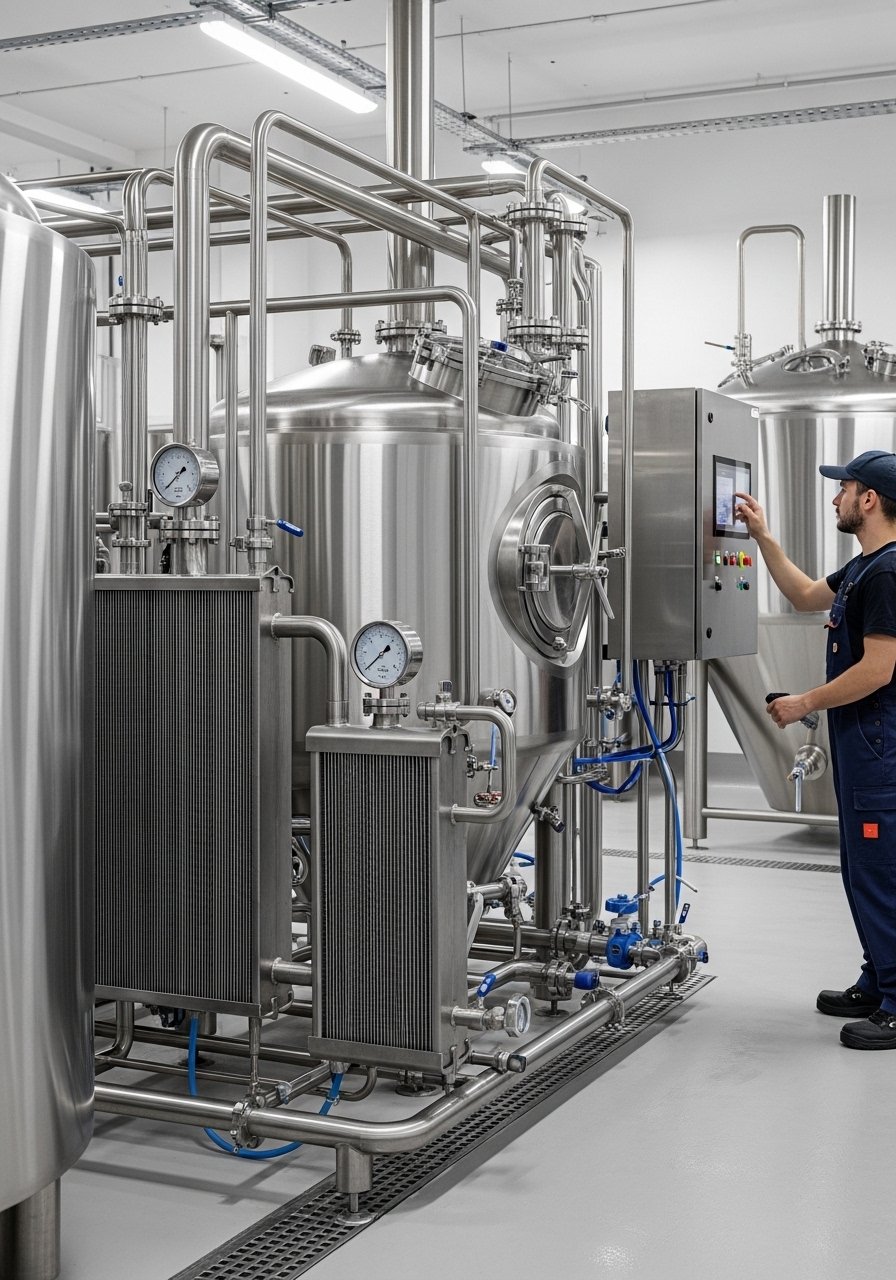
The Plate Heat Exchanger: How It Works
The plate heat exchanger is the bridge between the hot side and cold side. It drops wort from boiling temperature to pitching temperature in minutes using counterflow cooling.
Hot wort flows between stainless plates in one direction while cold water and/or glycol flow in the opposite direction. This counterflow arrangement maximizes heat transfer efficiency across the full length of the exchanger.
In many professional systems, a two-stage exchanger is used: cold water handles the first major temperature drop, and glycol handles final cooling to pitching temperature.
How the Cold Side Works: Converting Wort Into Beer
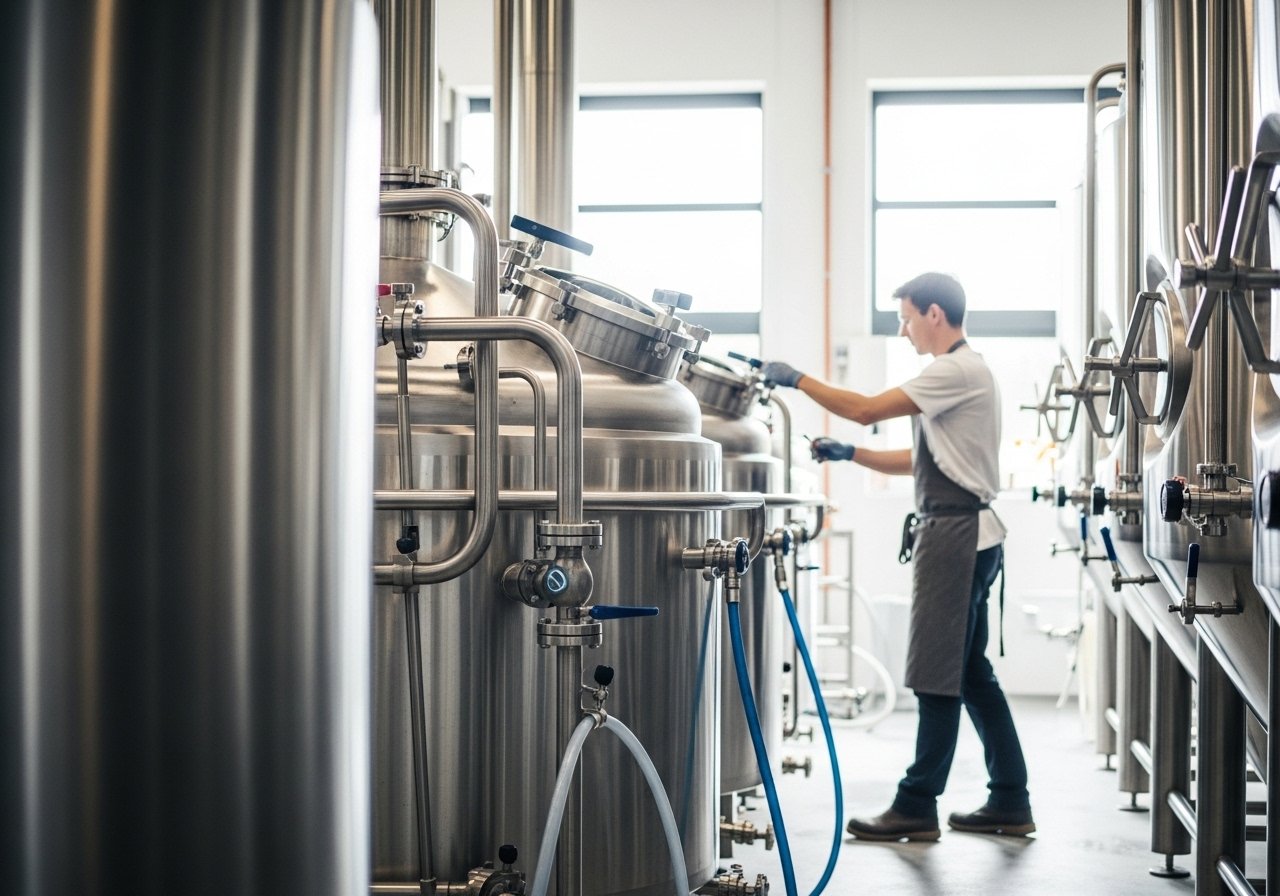
Commercial Conical Fermenters: How They Work
Once chilled wort enters the fermenter and yeast is pitched, fermentation begins. Commercial conical fermenters are cylindroconical vessels with precise temperature control, pressure capability, sanitary fittings, and cone bottoms for yeast and trub handling.
- Cooling jacket: glycol circulates through the jacket to hold precise fermentation temperatures.
- Cone bottom: allows trub dumping during fermentation and clean yeast harvest after cold crash.
- Pressure rating and PRV: supports closed transfer and natural carbonation via spunding.
- Tri-clamp fittings: standardized sanitary connections used across professional breweries.
- CIP sprayball: cleans and sanitizes the vessel interior without disassembly.
The Glycol Chilling System: How It Works
The glycol system is the refrigeration backbone of the brewery. A central chiller cools a reservoir of food-grade propylene glycol to around 28–32°F (-2 to 0°C). That chilled solution is circulated through the jackets of fermenters, brite tanks, and other cold-side vessels.
Each vessel has its own controller and valve, so glycol flow opens and closes automatically based on the vessel’s actual temperature versus the setpoint. The glycol system must be sized for peak load, not just average load, especially when multiple fermenters are actively fermenting at the same time.
The Brite Beer Tank (BBT): How It Works
After fermentation and cold crashing, finished beer is transferred under CO₂ pressure to the brite tank for final conditioning, carbonation, and clarity settling.
- Beer is moved via closed transfer to prevent oxygen pickup.
- Carbonation happens through force carbonation or spunding.
- Residual particles settle during 3–7 days of cold conditioning.
- Beer is sampled daily for carbonation, temperature, and sensory readiness before packaging.
Vessel Configurations: 2-Vessel vs. 3-Vessel vs. 4-Vessel Systems
The number of hot-side vessels in a brewhouse directly affects daily throughput, footprint, and capital cost.
| Configuration | Best For | Batches / Day | Capital Cost |
|---|---|---|---|
| 2-Vessel | Nano brewery / brewpub | 1–2 | Low |
| 3-Vessel | Startup microbrewery | 2–4 | Moderate |
| 4-Vessel | Production brewery | 4–8 | High |
A 2-vessel system combines mash/lauter and kettle/whirlpool, making it compact and affordable. A 3-vessel system separates mash and lauter, allowing more overlap between batches. A 4-vessel system separates all four stages and enables maximum parallel production.
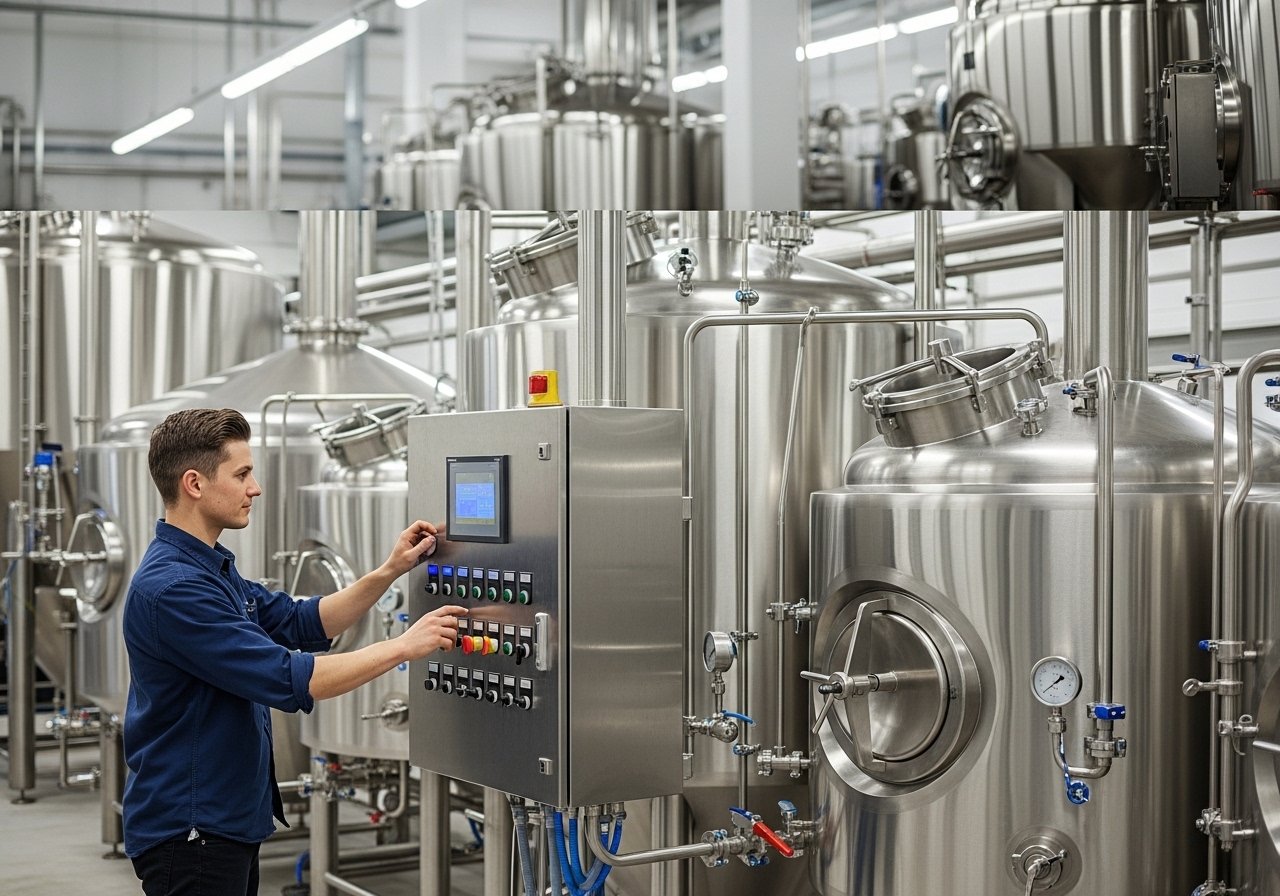
The Control System: How Commercial Breweries Automate the Process
Modern commercial breweries often use PLC-based control systems with touchscreen HMIs. These systems automate temperature control, pump and valve sequencing, recipe execution, alarm handling, and data logging.
- Temperature management using PID control loops
- Pump and valve automation for repeatable transfers
- Recipe management for mash profiles, boil times, and fermentation schedules
- Alarm systems for deviations and failures
- Data logging for quality control, troubleshooting, and compliance
PLC/HMI with recipe control, VFD pumps, mash/lauter temp PIDs, knockout setpoint control, and data logging delivers the strongest return on investment at commercial scale.
Utilities: What Commercial Brewing Equipment Needs to Operate
Commercial brewing equipment does not work in isolation. It depends on properly planned infrastructure across the entire facility.
- Electricity for motors, pumps, controls, lighting, and electric heating
- Water supply and treatment for brewing, cleaning, and cooling
- Natural gas where direct fire or boilers are used
- Drainage and wastewater handling sized for brew day and CIP peak flow
- Ventilation for steam exhaust and CO₂ safety
- Compressed air for packaging equipment and controls
The Sanitation System (CIP): How It Works
Clean-In-Place systems are how commercial breweries clean and sanitize vessels and piping without disassembly. A CIP skid heats, pumps, and often recovers cleaning solutions, sending them through sprayballs and sanitary circuits.
| CIP Step | Purpose |
|---|---|
| Hot water pre-rinse | Flush bulk organic residue like wort, yeast, and trub |
| Caustic recirculation | Dissolve proteins and organic soils |
| Water rinse | Remove caustic and verify neutral pH |
| Acid wash | Remove beerstone and mineral scale |
| Water rinse | Remove acid residue |
| Sanitizer application | Apply final no-rinse sanitizer such as PAA |
The full CIP cycle typically takes 60–90 minutes per vessel. In modern breweries, these cycles are often automated through the PLC control system.
Frequently Asked Questions
How does a commercial brewing system work from start to finish?
A commercial brewing system converts grain, water, hops, and yeast into beer through a sequence of milling, mashing, lautering, boiling, whirlpooling, chilling, fermenting, conditioning, and packaging.
What is the difference between a mash tun and a brew kettle?
A mash tun is where grain and hot water are mixed so enzymes can convert starches into sugars. A brew kettle is where the resulting wort is boiled, sterilized, and hopped.
How does a commercial fermenter control temperature?
Commercial fermenters use glycol-filled cooling jackets and temperature controllers that open and close glycol flow to maintain the target temperature profile.
What is the purpose of the whirlpool in a commercial brewery?
The whirlpool removes trub, hop matter, and coagulated proteins from hot wort before it reaches the heat exchanger and fermenter.
What heating method is best for a startup microbrewery?
For many 3–7 BBL startups, electric heating is the most practical. Direct fire becomes attractive where natural gas is available, and steam is usually best for 10 BBL+ production-scale breweries.
How many fermenters does a commercial brewery need?
A common industry rule is to have roughly 4–6x brewhouse volume in fermenter capacity, plus 1–2 brite tanks, to avoid cellaring bottlenecks.
What does PLC automation do in a commercial brewery?
PLC automation handles temperature control, pump and valve sequencing, recipe execution, alarms, and data logging so that processes run more consistently and with less manual intervention.
Summary: How Commercial Beer Brewing Equipment Works — At a Glance
| Equipment | Function | Key Process |
|---|---|---|
| Malt Mill | Crack grain to expose starch | Mechanical |
| Hot Liquor Tank | Heat and hold process water | Thermal |
| Mash Tun | Convert grain starches to sugars | Enzymatic |
| Lauter Tun | Separate wort from spent grain | Filtration |
| Brew Kettle | Boil, hop, and sterilize wort | Thermal / Chemical |
| Whirlpool | Remove trub from wort | Centripetal / Gravity |
| Plate Heat Exchanger | Chill wort to pitching temperature | Thermal transfer |
| Conical Fermenter | Ferment wort into beer | Biological / Glycol |
| Glycol Chilling System | Maintain precise cold-side temperatures | Refrigeration |
| Brite Beer Tank | Final conditioning and carbonation | Pressure / Cold |
| CIP System | Clean and sanitize all vessels in place | Chemical / Thermal |
| PLC Control Panel | Automate and log brewing processes | Electrical / Software |
Ready to Build a Commercial Brewery That Works?
Understanding how commercial beer brewing equipment works is the foundation of making smart decisions when you’re building or upgrading your brewery. The best-performing system is the one where every component is properly matched, sized, and integrated for your production goals.
